








- The Federal Reserve’s 2026 bank stress test confirmed all major U.S. banks remain well-capitalized despite absorbing over $708 billion in hypothetical loan losses.
- Aggregate capital declined only 1.6 percentage points, staying comfortably above minimum regulatory requirements.
- JPMorgan announced a $50 billion share buyback and Goldman Sachs raised its dividend following the stress test results.
- Core PCE inflation rose to 3.3% in April 2026, dampening hopes for near-term rate cuts.
- AI adoption in banking is accelerating, with JPMorgan planning a consumer-facing AI travel agent pilot before year-end.
What Happened?
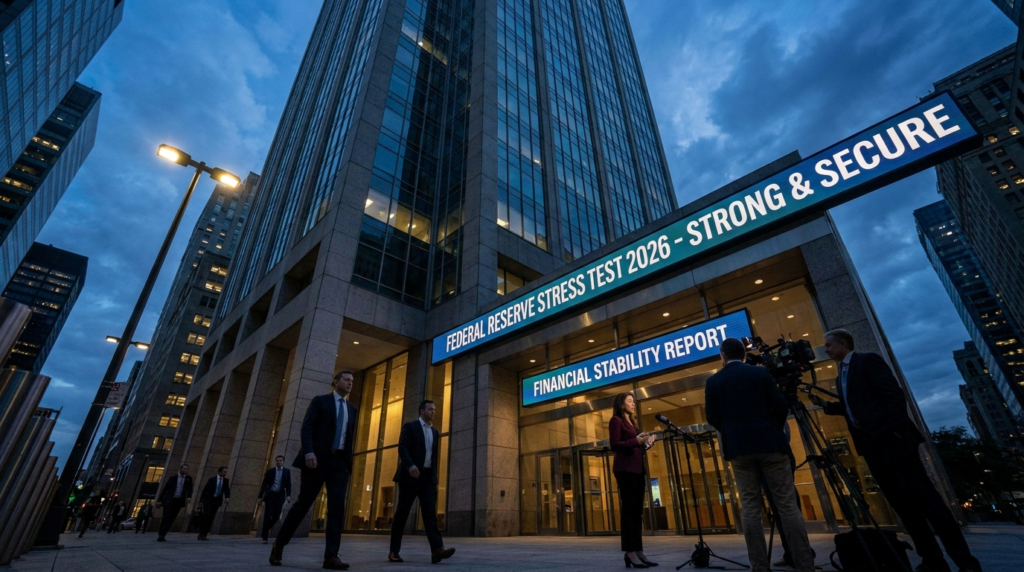
The Federal Reserve released its annual bank stress test results on June 24, 2026, delivering a clear verdict: the largest U.S. banks are built to withstand even the worst economic storms. The central bank stress test put 22 major financial institutions through a hypothetical severe recession scenario — one featuring soaring unemployment, collapsing real estate prices, and widespread credit defaults — and every one of them passed.
Despite absorbing more than $708 billion in total hypothetical loan losses, the aggregate capital ratio across participating banks declined by just 1.6 percentage points, remaining well above the minimum capital requirements set by regulators. This bank stress test result sent an immediate signal to markets: the financial system is fundamentally sound.
The timing couldn’t be more relevant. With core PCE inflation rising from 3.0% in December 2025 to 3.3% in April 2026, the Fed has maintained its cautious stance on interest rate cuts, keeping borrowing costs elevated. Against this backdrop, the bank stress test findings reassured investors that major lenders have sufficient capital buffers to keep lending to households and businesses even if economic conditions deteriorate sharply.
JPMorgan Chase wasted no time responding to the green light from the bank stress test, announcing a massive $50 billion share buyback program. Goldman Sachs followed suit by raising its quarterly dividend. Both moves are only possible when banks demonstrate excess capital above regulatory minimums — exactly what the stress test confirmed.
Why It Matters
The Federal Reserve’s bank stress test is one of the most closely watched events in the financial calendar, and for good reason. It directly influences how much capital banks must hold, which in turn determines how aggressively they can lend, buy back shares, or pay dividends. A clean bill of health means more money flowing into the economy.
This year’s bank stress test carries particular weight given the uncertain macroeconomic environment. Elevated energy prices have caused investors to revise their rate-cut expectations upward — where markets once priced in one or two Fed rate cuts in 2026, many now anticipate the central bank staying on hold or even tightening further. In that environment, a bank stress test result confirming strong capital ratios is reassuring.
Beyond the headline numbers, the bank stress test also revealed important trends about where banks are vulnerable. The hypothetical scenario modeled a commercial real estate downturn, which remains a pressure point for some regional lenders. While the largest banks passed comfortably, the bank stress test underscores why monitoring ongoing risks in the commercial property sector matters for the broader financial system.
According to a recent analysis of global banking trends, central banks worldwide are taking similar proactive approaches to stress-testing their financial systems as inflation and geopolitical uncertainty persist into the second half of 2026.
Expert Analysis
Financial analysts and banking sector observers reacted positively to the bank stress test outcome, though many cautioned against complacency. The results confirm that post-2008 capital reforms have built meaningful resilience into the U.S. banking system — a resilience that is now being tested in real-time by inflation, geopolitical instability, and the AI-driven restructuring of financial services.
On Reddit’s r/finance and r/investing communities, users highlighted the contrast between the solid bank stress test results and the ongoing commercial real estate uncertainty. One frequently upvoted thread noted that while the big banks passed the bank stress test with room to spare, smaller regional banks — not included in the Fed’s stress test — may face more pressure if rates remain elevated into 2027.
On X (formerly Twitter), banking analysts noted that the $50 billion JPMorgan buyback is one of the largest in the company’s history, signaling CEO Jamie Dimon’s confidence in the lender’s capital position after the bank stress test cleared the way. Goldman Sachs’s dividend increase was similarly well-received.
The National Bank of Greece’s completion of a core banking system transformation with Infosys — implementing the Finacle platform — was flagged by technology analysts as evidence that legacy bank infrastructure is being rapidly modernized across global markets, not just in the United States.
Bank Stress Test Market Impact
The immediate market reaction to the bank stress test results was strongly positive for financial sector stocks. JPMorgan shares climbed following the buyback announcement, while Goldman Sachs rose on the dividend increase news. The broader banking rally also contributed to broader equity market strength seen in the week following the release.
However, the market impact of the bank stress test wasn’t uniformly positive. Investors remain cautious about the inflation picture, with core PCE holding at 3.3% — a figure that gives Fed policymakers less room to pivot toward rate cuts. Higher-for-longer rates mean continued pressure on loan demand and net interest margins, even for well-capitalized banks.
In the bond market, yields remained elevated in the days following the bank stress test results, reflecting ongoing uncertainty about the Fed’s path. Analysts at major investment banks have revised their rate-cut forecasts, with some now expecting no reductions in 2026 at all — a scenario that would keep lending conditions tight even as the bank stress test confirms capital adequacy.
Lagos-headquartered Interswitch Group’s selection of Temenos solutions to expand cloud-hosted banking services across Africa was another signal that the bank stress test environment is pushing financial institutions globally to invest in more efficient, scalable technology platforms.
AI Transforming Banking in 2026
Beyond the bank stress test results themselves, one of the most significant banking stories of June 2026 is the accelerating adoption of artificial intelligence across the sector. JPMorgan’s consumer and community banking division announced plans to pilot a consumer-facing AI travel agent before year-end — a move that represents a significant expansion of AI from back-office automation into direct customer interaction.
First Commerce Bank in New Jersey is migrating to FIS’s Horizon core banking platform specifically to enable the adoption of new AI capabilities, including standardized data feeds and agentic commerce tools. This trend is playing out across dozens of mid-sized and regional banks that are choosing to overhaul aging core systems to gain access to modern AI infrastructure.
The bank stress test results, paradoxically, may accelerate this AI investment cycle. Banks with confirmed excess capital — as demonstrated by the bank stress test — now have greater financial flexibility to make long-term technology investments. With margins under pressure from elevated rates, cutting operational costs through AI automation is one of the most attractive levers available to bank CFOs.
The convergence of bank stress test resilience and AI transformation is reshaping the competitive dynamics of the U.S. banking industry. Large, well-capitalized institutions with the resources to invest in AI at scale are widening the gap between themselves and smaller competitors. The bank stress test, in this sense, is not just a regulatory exercise — it’s a map of which institutions have the financial firepower to lead the next phase of banking evolution.
Who: 22 major U.S. banks including JPMorgan Chase and Goldman Sachs
What: Federal Reserve bank stress test results confirming capital resilience
When: Released June 24, 2026
Where: United States (Federal Reserve announcement)
Why: Annual regulatory exercise to test bank resilience against severe recession scenarios
Impact: JPMorgan $50B buyback, Goldman dividend increase; market confidence in financial system stability
Frequently Asked Questions
What is the Federal Reserve bank stress test?
The Federal Reserve bank stress test is an annual regulatory exercise that subjects large U.S. banks to hypothetical severe economic scenarios — including deep recessions, collapsing real estate markets, and surging unemployment — to determine whether they hold enough capital to keep operating and lending through a crisis. Banks that pass the bank stress test gain greater flexibility to return capital to shareholders.
What were the 2026 bank stress test results?
In 2026, the bank stress test found that 22 major U.S. banks absorbed over $708 billion in hypothetical loan losses while capital declined only 1.6 percentage points — remaining above minimum requirements. All banks passed, prompting JPMorgan to announce a $50 billion buyback and Goldman Sachs to raise its dividend.
How does the bank stress test affect interest rates and lending?
The bank stress test does not directly set interest rates, but its results influence how much capital banks must hold versus deploy. Strong bank stress test results give banks more flexibility to lend and invest, which can support economic activity even in a higher-rate environment.
Why is AI adoption accelerating in banking in 2026?
With interest margins under pressure and operational costs rising, banks see AI automation as a key lever to improve efficiency. The bank stress test results showing strong capital positions also give major banks more financial flexibility to fund large-scale AI transformation programs.
Conclusion
The Federal Reserve’s 2026 bank stress test delivered exactly what the financial system needed: confirmation that America’s largest banks can absorb massive shocks and keep the credit flowing. With $708 billion in hypothetical losses absorbed and capital ratios holding above minimums, the bank stress test results have unlocked billions in shareholder returns and reinforced confidence in a sector navigating real challenges — from sticky inflation to the urgent need for AI-driven transformation.
The road ahead isn’t without bumps. Elevated rates, commercial real estate stress, and the competitive threat from fintech challengers mean banks cannot afford complacency. But the bank stress test has made one thing clear: the financial architecture built since 2008 is working. And the banks using that resilience to invest in AI today are likely to be the ones writing the next chapter of American banking.
Sources
- Federal Reserve: 2026 Bank Stress Test Results
- American Banker: Banking Sector Analysis
- Fintech Futures: Top Banking Technology Stories June 2026
Disclaimer: This article is for informational purposes only and does not constitute financial advice. Past performance is not indicative of future results.