






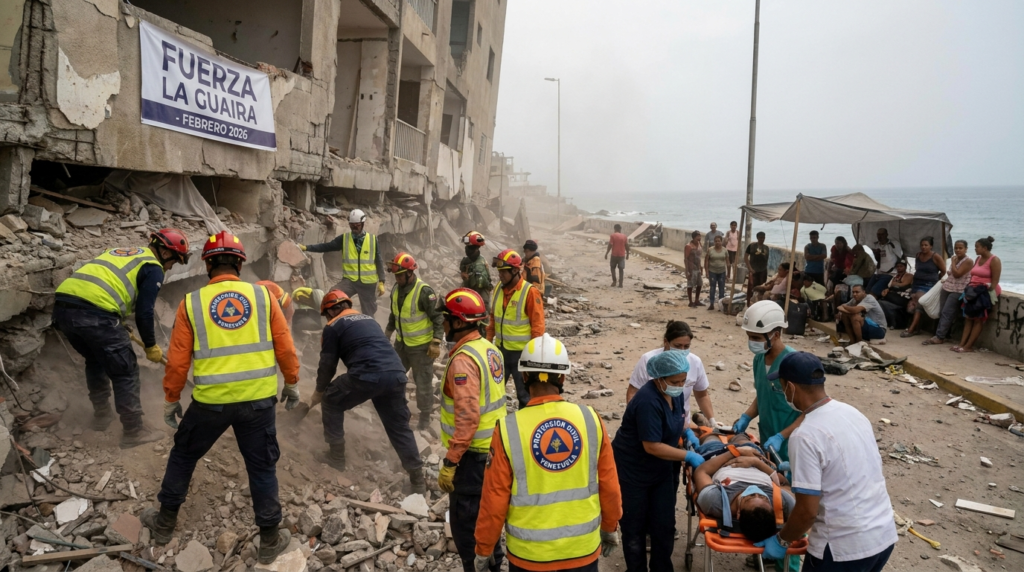

- The Venezuela earthquake death toll has climbed to at least 920 as of June 28, 2026, making it one of the deadliest natural disasters in the country’s recent history.
- U.S. search and rescue teams have joined Venezuelan emergency responders in La Guaira, racing against the critical 72-hour survival window.
- Multiple buildings collapsed in coastal and urban areas, with thousands of residents displaced and infrastructure severely damaged.
- The earthquake struck a region still struggling with economic instability, complicating the humanitarian response.
- International aid from the U.S., Red Cross, and neighboring nations is converging on the affected region.
What Happened?
A devastating earthquake struck Venezuela, with La Guaira among the worst-hit areas, sending shockwaves through a country already burdened by years of economic hardship. The Venezuela earthquake death toll stood at at least 920 as of Saturday, June 28, 2026, according to reports from Venezuelan officials and international emergency monitoring agencies. Thousands more are injured, and the true scale of casualties remains uncertain as rescue teams work to reach areas where building collapses have cut off access routes.
The Venezuela earthquake struck with devastating force in the coastal region, toppling residential buildings, commercial structures, and critical infrastructure. La Guaira — Venezuela’s main port city and a densely populated urban center — suffered some of the most severe damage, with entire apartment blocks reduced to rubble. The scenes unfolding are reminiscent of past Caribbean and South American earthquake disasters, where dense urban construction, often without modern seismic standards, amplifies the human toll dramatically.
American search and rescue teams arrived in La Guaira within hours of the disaster, joining Venezuelan emergency responders in what rescue specialists describe as a race against the biological clock. The critical 72-hour survival window — the period during which survivors trapped under rubble have the highest chance of being found alive — is closing rapidly. Every hour matters when concrete and steel have buried entire families in their homes.
Why It Matters
The Venezuela earthquake is the leading global humanitarian story of this moment, and its significance extends far beyond the immediate tragedy. Venezuela is a nation that has spent the better part of a decade in severe economic crisis — hyperinflation, emigration of millions of citizens, and deteriorated public infrastructure have left the country ill-equipped to respond to a natural disaster of this magnitude.
For the international community, the Venezuela earthquake presents both a humanitarian imperative and a geopolitical complexity. U.S.-Venezuelan relations have been fraught for years, yet American search and rescue teams are on the ground, demonstrating that disaster response transcends diplomatic tensions. The speed and scale of that response will be watched closely by human rights organizations, regional governments, and Venezuelan citizens alike.
The economic dimension of the Venezuela earthquake cannot be ignored. La Guaira is the country’s primary seaport — damage to its infrastructure will ripple through Venezuela’s already fragile economy, affecting oil exports, food imports, and the broader supply chains that the population depends on for survival. Rebuilding will require international financing and expertise that Venezuela’s current government may struggle to secure or coordinate.
On a human level, the Venezuela earthquake lands in communities where many families have already watched siblings, children, and parents emigrate to Colombia, Peru, Chile, and beyond in search of economic opportunity. The disaster may trigger a new wave of displacement — internal and external — adding pressure to regional migration patterns that neighboring nations are still working to absorb.
Expert Analysis
Seismologists monitoring the Venezuela earthquake noted that the affected region lies near known fault systems in the Caribbean tectonic zone, which has produced significant seismic events historically. The 1967 Caracas earthquake and the 2010 Haiti disaster are grim reference points for researchers studying earthquake preparedness in Caribbean and South American nations with aging urban building stock.
On social media platforms, the Venezuela earthquake generated enormous engagement, with the hashtag trending across X (Twitter), Facebook, and Instagram within hours of the first reports. Users in the Venezuelan diaspora community — millions of whom live in Colombia, Peru, and the United States — flooded social platforms with desperate requests for information about family members in La Guaira and the surrounding areas.
YouTube channels covering humanitarian crises saw a surge in viewership for Venezuela earthquake coverage, with documentary-style live streams from local journalists and NGO workers on the ground drawing hundreds of thousands of viewers. The real-time nature of digital media coverage is shaping the public’s understanding of the disaster far faster than traditional news cycles can move.
Humanitarian aid organizations including the Red Cross and Doctors Without Borders (Médecins Sans Frontières) issued emergency appeals within hours of the Venezuela earthquake striking, mobilizing field teams and financial resources. Early assessments suggest that medical capacity in La Guaira was severely strained even before the earthquake — the disaster has overwhelmed what remained of the local healthcare infrastructure.
Venezuela Earthquake Rescue Operations
The Venezuela earthquake rescue operation is a complex, multi-agency undertaking being conducted under extreme time pressure and difficult physical conditions. U.S. Rescue teams, operating under USAID’s Office of U.S. Foreign Disaster Assistance (OFDA), brought specialized urban search and rescue (USAR) capabilities including acoustic listening devices, trained search dogs, and heavy technical equipment to locate and extract survivors from collapsed structures.
Venezuelan civil protection units, military personnel, and volunteer rescuers have been working alongside international teams since the first hours after the Venezuela earthquake. The coordination between domestic and international responders — typically complicated by language, logistical, and jurisdictional factors — has reportedly proceeded with urgency overriding bureaucratic barriers, given the scale of the disaster.
The Venezuela earthquake has also brought an outpouring of civilian volunteers, many of them diaspora members who returned to help their families and communities. Accounts from rescue workers describe scenes of extraordinary human bravery — neighbors digging through rubble with bare hands, local doctors treating the injured in makeshift outdoor facilities, and community networks organizing food and water distribution for the displaced.
Critical infrastructure damage from the Venezuela earthquake extends beyond buildings. Roads linking La Guaira to Caracas were damaged, initially slowing the movement of rescue equipment and personnel. Emergency repair crews worked through the night to restore critical access routes, while helicopter airlifts became the primary means of evacuating the most seriously injured to hospitals in the capital.
Humanitarian Impact and International Response
The Venezuela earthquake has displaced tens of thousands of people, creating an acute humanitarian need for emergency shelter, clean water, food, and medical care. Displacement camps are being established in school buildings, sports facilities, and open spaces around La Guaira — but the scale of the displacement threatens to overwhelm available resources rapidly.
The United States announced emergency humanitarian assistance in response to the Venezuela earthquake, with USAID activating its Disaster Assistance Response Team (DART). Colombia, which shares a border with Venezuela and hosts the largest Venezuelan diaspora community, also offered emergency support. Brazil and Peru issued statements of solidarity and pledged search and rescue support.
The Venezuela earthquake struck at a moment when the country’s public health system was already severely undermined by years of economic sanctions, medical supply shortages, and emigration of trained healthcare professionals. Reports from international medical NGOs suggest that surgical capacity and blood supply in La Guaira hospitals were overwhelmed within the first 24 hours, necessitating medical airlift to Caracas and emergency field hospital deployment.
Longer-term reconstruction presents a profound challenge. Economic resilience is critical for disaster recovery, yet Venezuela’s GDP has been contracting for nearly a decade. Rebuilding La Guaira’s port infrastructure, residential areas, and public services will require international financing mechanisms — potentially including multilateral development bank emergency funds and bilateral aid programs from regional partners.
The Venezuela earthquake response will test international solidarity at a moment when global attention is already stretched across multiple humanitarian emergencies. From the wildfires devastating southern Utah to food insecurity across the Sahel, the competition for donor attention and emergency funding is fierce. Aid organizations are urging donors worldwide not to allow Venezuela earthquake victims to slip from global consciousness once the initial dramatic rescue phase concludes.
Who: Venezuelan population in La Guaira and surrounding regions; U.S. and international rescue teams
What: Major earthquake causing 920+ deaths and massive structural destruction
When: Earthquake struck June 2026; rescue operations ongoing as of June 28
Where: La Guaira, Venezuela (Caribbean coast)
Why: Seismic activity in Caribbean fault zone; aging urban infrastructure amplified casualties
Impact: 920+ dead, thousands injured and displaced, port infrastructure damaged, international humanitarian response mobilized
Frequently Asked Questions
How many people have died in the Venezuela earthquake?
The Venezuela earthquake death toll stood at at least 920 as of June 28, 2026. Rescue operations are ongoing and the true death toll is expected to rise as search teams reach more areas of building collapse in La Guaira and surrounding communities.
Why is La Guaira so significant in the Venezuela earthquake?
La Guaira is Venezuela’s principal seaport and a densely populated coastal city. Its strategic role as the country’s main gateway for imports and exports means that the Venezuela earthquake’s damage to La Guaira has both immediate humanitarian consequences and significant economic implications for the entire country.
What is the 72-hour survival window in earthquake rescue?
The 72-hour survival window refers to the critical period immediately after an earthquake during which individuals trapped under rubble have the highest probability of being found alive. After 72 hours, survival rates decline sharply due to dehydration, injury complications, and structural instability. This is why the Venezuela earthquake rescue operation is being conducted with extreme urgency.
Is the U.S. helping with Venezuela earthquake relief?
Yes. Despite historically strained diplomatic relations with Venezuela’s government, U.S. search and rescue teams from USAID’s OFDA arrived in La Guaira to join rescue operations. The U.S. also announced emergency humanitarian assistance, activating its Disaster Assistance Response Team (DART) for the Venezuela earthquake response.
Conclusion
The Venezuela earthquake is a tragedy unfolding in real time, and the world is watching. With at least 920 lives lost and thousands more in peril, the human cost of this disaster is staggering — made worse by the economic devastation that already gripped the country before the first tremor struck. La Guaira’s collapsed buildings and overwhelmed hospitals are not just a story of natural disaster; they’re a story of what happens when seismic risk meets institutional fragility.
In the hours and days ahead, the Venezuela earthquake rescue operation will reach a turning point as the survival window closes and the response shifts from rescue to recovery. The international community’s commitment — measured not just in the immediate rescue effort but in the sustained reconstruction support that follows — will determine whether Venezuela can begin to rebuild. The victims of the Venezuela earthquake deserve nothing less than the full force of global solidarity.
Sources
- Fox News: Venezuelan Earthquake Death Toll Hits 920
- NPR: World News and International Coverage
- US News: World News Headlines
Disclaimer: This article is for informational and news reporting purposes only. All figures cited are based on reports available as of June 28, 2026, and may change as the situation evolves.