








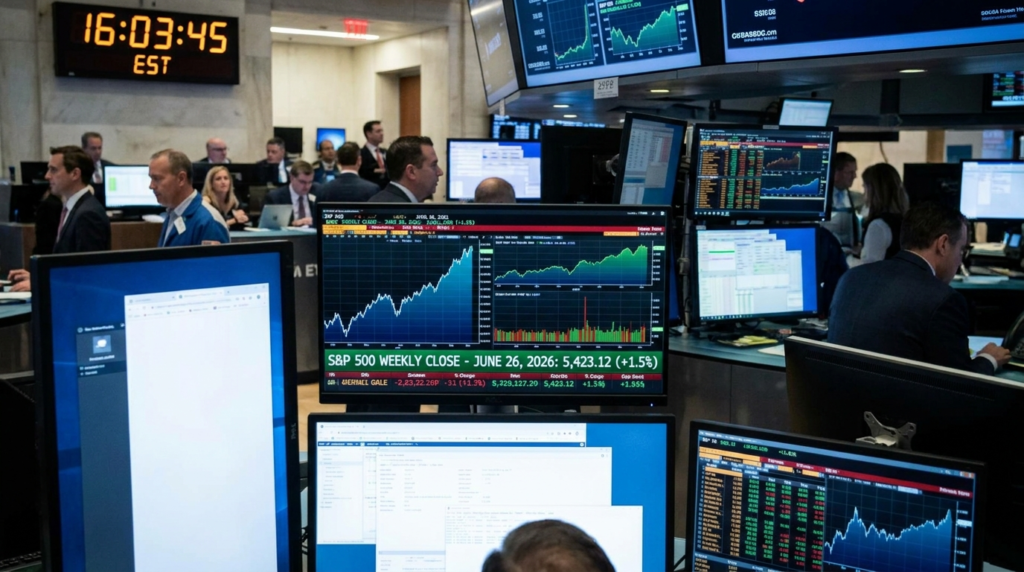

- The S&P 500 closed slightly lower on June 28, down 0.05%, as chipmakers trimmed gains from Thursday’s semiconductor-driven rally.
- Eli Lilly soared 7% after the EU approved its new leukemia therapy, signaling continued strength in pharma.
- Microsoft gained 5.71%, Salesforce rose 5.45%, and IBM added 5.08% to lead the weekly S&P 500 winners.
- Oil markets stabilized after evidence that Strait of Hormuz tanker traffic continued, easing energy supply fears.
- University of Michigan Consumer Sentiment consensus stands at 48.9 — a multi-year low reflecting persistent economic anxiety.
What Happened?
The S&P 500 ended the trading week on a cautious note, inching down just 0.05% on Friday, June 28, 2026, as investors locked in profits from Thursday’s semiconductor-driven surge. The index’s modest decline masked a week of significant underlying action — a week that saw the Dow Jones touch an intraday record high of 52,655, Micron surge 17% on blowout AI memory earnings, and the Federal Reserve’s bank stress test clear the way for billions in bank shareholder returns.
The S&P 500’s week told a tale of two markets. Technology and AI-adjacent names soared. Microsoft climbed 5.71% on the week, Salesforce added 5.45%, and IBM gained 5.08% — all three benefiting from investor enthusiasm about enterprise AI adoption and the revenue streams it is beginning to generate for established software companies. These moves pushed the S&P 500 technology sector near all-time highs.
On the other side of the S&P 500 ledger, industrial and financial sector stocks gave back ground on Friday after strong midweek gains. Caterpillar fell 5.67%, Cisco dropped 4.56%, and Goldman Sachs pulled back 4.07%. The rotation from cyclicals to tech was a familiar pattern — one that suggests S&P 500 investors remain more comfortable with AI-driven growth stories than with traditional economic-cycle names.
Healthcare delivered the week’s most dramatic single-stock story: Eli Lilly surged 7% after the European Union backed the use of its leukemia therapy, expanding the drug’s addressable market significantly and reinforcing Lilly’s position as the most valuable pharmaceutical company in the world by market capitalization.
Why It Matters
The S&P 500’s resilience through a week of complex macro signals — elevated inflation, geopolitical oil supply concerns, mixed corporate earnings — demonstrates the degree to which AI-driven earnings growth has become the index’s primary support beam. Strip out the AI-adjacent tech names, and the S&P 500’s performance this week would look considerably more muted.
That concentration risk is something S&P 500 investors and financial advisors are paying close attention to. When a small number of mega-cap technology companies account for a disproportionate share of both S&P 500 index gains and market capitalization, the index’s performance can diverge significantly from the broader economy’s health. The University of Michigan Consumer Sentiment reading — consensus at just 48.9 — is a reminder that the typical American household is not experiencing the same economic reality as S&P 500 shareholders.
The S&P 500’s interest rate sensitivity also deserves attention. Core PCE inflation rising to 3.3% in April 2026 has pushed rate-cut expectations firmly into the background, with some economists now forecasting no Fed cuts in 2026 at all. In a higher-for-longer rate environment, S&P 500 valuations — which remain historically elevated — depend on continued earnings growth delivering on the premium the market is paying for future profits.
For individual investors, the S&P 500’s week underscores the importance of staying informed about sector rotation dynamics. Global finance trends in 2026 show that capital is flowing toward AI, healthcare innovation, and financial sector names with strong balance sheets — and away from consumer-facing businesses facing margin compression from elevated input costs.
Expert Analysis
Wall Street strategists entering the final trading day of June 2026 are broadly cautious about S&P 500 near-term direction. The index has been propped up by a handful of mega-cap tech names, while breadth — the proportion of S&P 500 stocks making new highs — has narrowed. Narrow market breadth is historically associated with elevated risk of correction, particularly when the macro environment is uncertain.
On Reddit’s r/investing and r/personalfinance, S&P 500 discussion this week centered on the Microsoft and Salesforce gains and what they signal about enterprise AI monetization. A widely-shared analysis argued that software companies are the ones best positioned to capture AI value in 2026 and 2027, because they can integrate AI capabilities into existing subscription products without the massive capital expenditure required to train frontier models.
On X (Twitter), financial analysts debated the implications of the 48.9 University of Michigan Consumer Sentiment reading for the S&P 500. A consensus view emerging from multiple analyst accounts is that consumer sentiment at these levels historically precedes a slowdown in discretionary spending — which could weigh on retail, hospitality, and consumer goods S&P 500 components in the coming months, even as the overall index holds steady on AI-driven tech strength.
Pharma investors are watching Eli Lilly’s 7% single-day gain with significant interest. The EU approval of its leukemia therapy is the latest in a series of regulatory wins that have made Lilly the defining big pharma story of the mid-2020s, alongside its blockbuster GLP-1 franchise in obesity and diabetes. Analysts see the leukemia therapy approval as opening a multi-billion-dollar addressable market in Europe.
S&P 500 Sector Breakdown
Analyzing the S&P 500 through a sector lens this week reveals a market in clear rotation. Technology and healthcare led. Industrials and communications underperformed.
Technology sector: Microsoft, Salesforce, and IBM led S&P 500 tech higher. The theme driving all three is the same: enterprise AI integration is generating measurable productivity gains and revenue, and investors are beginning to price in a multi-year AI monetization cycle for software companies. Microsoft’s Copilot integration across its Office suite and Azure cloud platform is the clearest example of an AI revenue model gaining mainstream adoption.
Healthcare sector: Eli Lilly’s 7% surge on EU leukemia approval drove healthcare to one of the best weekly performances in the S&P 500. The broader pharma pipeline is robust heading into the second half of 2026, with multiple blockbuster drug approvals expected across oncology, immunology, and metabolic disease categories. Market observers tracking sector leadership trends note that pharma and biotech are increasingly displacing pure tech names as the dominant S&P 500 growth story.
Financial sector: Post-stress test euphoria gave way to some profit-taking on Friday, with Goldman Sachs off 4.07% and JPMorgan pulling back modestly. The S&P 500 financial sector remains up strongly on the week, supported by the $50 billion JPMorgan buyback and Goldman’s dividend increase. Net interest margins remain healthy for large banks in the elevated-rate environment.
Industrials sector: Caterpillar’s 5.67% Friday drop was the biggest single-stock drag on the S&P 500 industrials sector. The company’s sensitivity to global economic growth expectations — particularly construction and mining activity — makes it a barometer for investor confidence in the broader economic cycle. Weakness in Caterpillar often signals that S&P 500 investors are trimming economic cyclical exposure.
Oil, Inflation, and Rate Outlook
Oil markets provided a measure of relief this week, with prices stabilizing after concerns about Strait of Hormuz disruptions proved overstated. Evidence that tanker traffic continued to flow through the strategically vital waterway improved the supply outlook from Middle Eastern energy producers, easing fears of a sharp crude oil price spike that could have reignited inflation significantly above current levels.
President Trump’s accusation that Iran violated a ceasefire agreement by firing at cargo ships transiting the Strait of Hormuz injected geopolitical uncertainty into energy markets mid-week. However, the actual physical flow of oil appeared largely uninterrupted, allowing prices to settle rather than spike. This matters enormously for the S&P 500 because an oil price surge would accelerate inflation and further reduce the likelihood of Fed rate cuts.
The inflation picture heading into July 2026 remains the single most important variable for S&P 500 direction. Core PCE at 3.3% in April is significantly above the Fed’s 2% target. The University of Michigan Consumer Sentiment figure of 48.9 reflects households’ lived experience of high prices — food, housing, insurance, and energy costs all remain elevated compared to pre-2022 levels.
For the S&P 500, a scenario where inflation stays sticky and the Fed holds rates through year-end is manageable as long as earnings continue to grow. But any deterioration in S&P 500 earnings estimates — driven by weaker consumer spending, higher borrowing costs for corporations, or an energy price shock — could trigger a more significant market correction from current elevated valuations.
Who: S&P 500 investors, Federal Reserve, oil markets, major U.S. corporations
What: S&P 500 ends week slightly lower; tech and pharma led; industrials retreated
When: Week closing June 28, 2026
Where: U.S. equity markets; geopolitical focus on Strait of Hormuz
Why: Post-semiconductor rally profit-taking; inflation uncertainty; Fed rate hold expectations
Impact: Microsoft +5.71%, Eli Lilly +7%, Caterpillar -5.67%; oil stable; rate-cut expectations further diminished
Frequently Asked Questions
Why did the S&P 500 fall slightly on June 28, 2026?
The S&P 500 declined 0.05% on June 28 as investors trimmed positions in chipmakers after Thursday’s semiconductor-driven rally. While Friday’s move was modest, it reflected caution about elevated valuations amid persistent inflation and uncertainty about Federal Reserve rate policy.
Why did Eli Lilly surge 7% this week?
Eli Lilly’s 7% gain came after the European Union approved the use of its leukemia therapy, significantly expanding the addressable market for the drug. The approval adds to Lilly’s growing portfolio of high-value specialty medicines and reinforces its position as a premier pharmaceutical S&P 500 component.
What is the University of Michigan Consumer Sentiment and why does it matter?
The University of Michigan Consumer Sentiment index measures how confident American households feel about economic conditions, including their personal finances, spending intentions, and economic outlook. A reading of 48.9 — the consensus for this release — reflects significant economic anxiety among consumers and is historically associated with reduced discretionary spending, which can weigh on S&P 500 consumer-sector companies.
What does Strait of Hormuz stability mean for S&P 500 investors?
The Strait of Hormuz is the world’s most important oil shipping chokepoint. If oil tanker traffic is disrupted there, crude prices spike, which accelerates inflation and reduces the likelihood of Federal Reserve rate cuts. Stability in the Strait is positive for the S&P 500 because it keeps a major inflation risk in check.
Conclusion
The S&P 500’s week ending June 28, 2026 was defined by selective strength rather than broad advance. Technology and healthcare led, supported by AI monetization and pharma regulatory wins. Industrials and communications stumbled. The index itself barely moved on Friday — but the story underneath was rich with signals about where capital is flowing and why.
Heading into the second half of 2026, the S&P 500 faces a clear-eyed reckoning: can earnings growth continue to justify elevated valuations in a higher-for-longer rate environment? The answer, based on the week’s evidence from Microsoft, Salesforce, Eli Lilly, and Micron, is a qualified yes — for the AI and pharma winners. For the rest of the S&P 500, the path is narrower and the margin for error is smaller.
Sources
- Charles Schwab: Stock Market Update June 2026
- Trading Economics: U.S. Stock Market Index Data
- Yahoo Finance: Markets News and Data
Disclaimer: This article is for informational purposes only and does not constitute investment advice. Investing involves risk, including the possible loss of principal. Consult a qualified financial advisor before making investment decisions.