








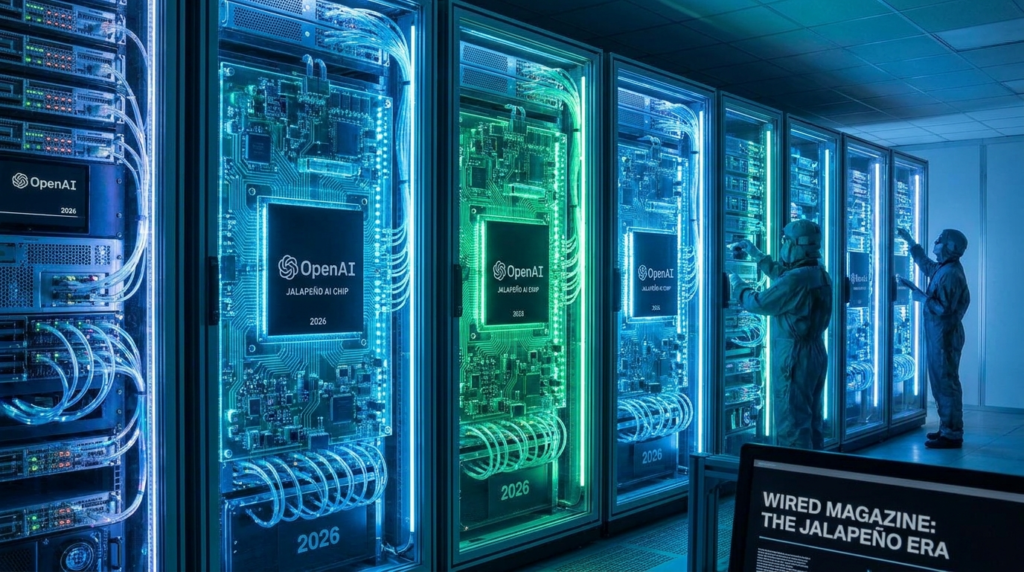

- OpenAI and Broadcom unveiled Jalapeño, OpenAI’s first custom-designed AI chip, on June 24, 2026 — marking a pivotal shift in AI infrastructure strategy.
- Google launched Gemini 2.5 Pro with Deep Think reasoning mode, achieving 82.4% on the GPQA Diamond benchmark — surpassing all competing frontier models.
- Apple announced its third-generation Apple Foundation Models (AFM 3) at WWDC 2026 in collaboration with Google, a landmark partnership.
- AI agents are emerging as the dominant enterprise technology trend of 2026, with Alteryx and others enabling business-process automation at scale.
- The Stanford AI Index 2026 reports that capabilities once requiring top frontier models six months ago are now baseline in smaller, cheaper models.
What Happened?
June 2026 will be remembered as a watershed month for artificial intelligence and information technology. On June 24, OpenAI and Broadcom jointly unveiled Jalapeño — OpenAI’s first custom-designed AI chip. The announcement marks a fundamental strategic shift: OpenAI is no longer solely dependent on NVIDIA’s GPU infrastructure, and the implications for the entire AI chip market are profound. Jalapeño is designed specifically for inference workloads — running trained AI models at scale, cheaply and efficiently — the workload that is increasingly dominating AI compute demand as deployment surpasses training in commercial importance.
Days earlier, Google launched Gemini 2.5 Pro with Deep Think reasoning mode on June 22, 2026, producing benchmark results that reset the AI leaderboard. The model achieved 82.4% on GPQA Diamond — a benchmark testing graduate-level physics, chemistry, and biology — surpassing competing frontier models including what the AI information technology community has been tracking as the leading benchmarks. The Deep Think reasoning mode enables Gemini 2.5 Pro to decompose complex, multi-step problems in ways that earlier AI systems consistently struggled with.
Apple made its own major AI move at WWDC 2026 on June 8, announcing the third-generation Apple Foundation Models (AFM 3) — a family of five models developed in a landmark collaboration with Google. The Apple-Google AI partnership is particularly striking given the companies’ history as intense competitors in mobile and advertising. It signals that even the deepest strategic rivals are finding cooperation necessary in the AI capabilities race.
Meanwhile, the Stanford AI Index 2026, released this month, delivered a stunning finding: AI capabilities that required top-tier frontier models just six months ago are now baseline features of smaller, cheaper models. The time between a frontier capability’s debut and its commoditization has compressed from years to months — a pace of democratization that is reshaping the competitive landscape for every company deploying AI in its products.
Why It Matters
The AI chip announcement from OpenAI and Broadcom matters because it changes the economics of artificial intelligence at the infrastructure level. NVIDIA has been the dominant supplier of AI training chips, with its H100 and successor GPU architectures earning extraordinary margins. But the AI industry’s hunger for inference compute — running billions of AI model queries per day — is creating an opportunity for custom silicon designed from the ground up for that specific workload.
Jalapeño is not OpenAI’s attempt to compete with NVIDIA in AI training. It is a purpose-built inference chip designed to make running ChatGPT, GPT-5, and future OpenAI models dramatically cheaper per query. If Jalapeño achieves even 30–40% cost reduction per AI inference operation, the financial impact on OpenAI’s unit economics is enormous — and the strategic importance of not being hostage to a single chip supplier is immeasurable in an era of geopolitical supply chain risk.
Google’s Gemini 2.5 Pro Deep Think result matters because it re-establishes Google as the frontier AI model leader after months during which OpenAI and Anthropic models dominated the benchmark conversation. For enterprise information technology buyers choosing AI platforms for 2026-2027 deployments, the model landscape has just become more competitive — and more interesting. A more competitive frontier model market means faster capability improvements and potentially lower API pricing as providers compete for developer and enterprise customers.
The Apple-Google AFM 3 collaboration is perhaps the most geopolitically and commercially surprising development. Apple’s on-device AI strategy has historically emphasized privacy and local compute, while Google’s cloud-first AI strategy has emphasized scale and connectivity. The AI market share battle is reshaping even the most established competitive dynamics in information technology.
Expert Analysis
AI researchers and technology analysts have been processing a dense information technology news cycle this month. On Hacker News, the Jalapeño announcement generated one of the most-commented threads of the year. The dominant view among technically sophisticated commenters is that OpenAI’s move into custom silicon is a logical and necessary evolution — not a sign that NVIDIA’s position is immediately threatened, but a clear signal that the largest AI labs are no longer willing to accept commodity GPU economics as a permanent constraint on their cost structures.
Reddit’s r/MachineLearning community was intensely focused on Gemini 2.5 Pro’s GPQA Diamond benchmark of 82.4%. Several researchers noted that GPQA Diamond questions are specifically designed to defeat pattern-matching approaches — they require genuine multi-step reasoning across domain boundaries. A model achieving 82.4% on this benchmark is not just a statistical achievement; it suggests that large language models are genuinely approaching expert-level reasoning in STEM domains.
On X (Twitter), AI commentators debated the implications of Apple and Google’s AFM 3 collaboration for on-device AI. The emerging consensus is that this partnership reflects both companies’ recognition that on-device AI is strategically critical for privacy-first markets — particularly in Europe, where the EU AI Act is creating strong incentives for AI systems that process data locally rather than transmitting it to cloud servers.
The Stanford AI Index 2026 finding — that capability democratization has accelerated dramatically — received widespread attention from enterprise IT leaders. For CIOs and CTOs making AI deployment decisions in 2026, the implication is clear: waiting for the “right” model before deploying AI is increasingly a losing strategy, because the model you’re waiting for may be commoditized before you finish evaluating it.
The AI Chip Revolution: Jalapeño Changes Everything
Understanding the significance of OpenAI’s Jalapeño chip requires appreciating the economics of AI at scale. Training a frontier AI model — the initial process of teaching it on vast datasets — is expensive and compute-intensive, but it happens once (or rarely). Running that model in production — answering user queries, generating content, performing reasoning tasks — is called inference, and it happens billions of times per day across OpenAI’s user base. The cost of inference is OpenAI’s largest recurring operating expense.
NVIDIA’s GPUs, designed originally for graphics and later adapted for AI training, are powerful but not optimally efficient for pure inference workloads. Custom inference chips — like Google’s TPUs, Amazon’s Trainium, and now OpenAI’s Jalapeño — can be architecturally optimized for the specific mathematical operations that inference requires, achieving significantly better performance per watt and performance per dollar than general-purpose GPUs.
Broadcom’s role in Jalapeño is significant. The semiconductor company has established itself as the leading partner for hyperscaler custom AI chip programs, having worked with Google on TPU development for years. Broadcom’s expertise in custom ASIC design and high-speed networking fabrics — the interconnects that link chips together in massive AI clusters — makes it an ideal partner for a first-time custom silicon effort from an AI software company like OpenAI.
The information technology competitive implications extend well beyond OpenAI and NVIDIA. Global AI infrastructure investment is accelerating, with nations and corporations racing to secure compute capacity. If custom AI chips from multiple labs begin to reduce dependence on NVIDIA’s ecosystem, the entire information technology supply chain for AI will evolve — creating new winners in chip packaging, memory, networking, and software tooling.
AI Agents Transforming Enterprise IT in 2026
Beyond model releases and chip announcements, the most practically impactful AI information technology trend of June 2026 is the rise of AI agents in enterprise settings. At its Inspire 2026 conference, Alteryx unveiled Agent Studio and an MCP (Model Context Protocol) Server — tools that allow business analysts to convert existing data workflows and business logic directly into autonomous agents capable of executing multi-step tasks without human intervention at each step.
The enterprise AI agent trend reflects a maturation in how businesses think about AI. Early AI deployments focused on point solutions: a chatbot here, a document summarization tool there. The agent paradigm represents something more fundamental — AI systems that can take goal-level instructions and break them down into the individual actions, tool calls, and decisions needed to accomplish them, operating autonomously across hours or days rather than responding to a single query.
The Federal Energy Regulatory Commission’s June 18 orders to all six U.S. regional grid operators — requiring them to propose reforms to allow large-load customers, specifically AI data centers, to connect to the power grid faster — underscores how deeply AI infrastructure demand is reshaping physical information technology systems. AI data centers are among the fastest-growing sources of electricity demand in the United States, and the power grid governance framework is scrambling to accommodate them.
The EU AI Act’s approach to major enforcement milestones is also shaping enterprise information technology strategy in Europe. Companies building AI-powered products are being forced to categorize their systems by risk level, implement human oversight mechanisms, and document AI decision-making processes in ways that create significant compliance overhead. For information technology leaders, AI governance is rapidly becoming as important a competency as AI development itself.
Who: OpenAI, Broadcom, Google, Apple, Alteryx, enterprise AI users worldwide
What: Jalapeño AI chip unveiled; Gemini 2.5 Pro tops benchmarks; AFM 3 Apple-Google partnership
When: June 8–28, 2026
Where: Global AI information technology industry
Why: Inference cost reduction, frontier model competition, enterprise AI agent adoption, EU regulatory pressure
Impact: AI chip supply chain disruption; model democratization accelerates; enterprise AI agent deployments surge
Frequently Asked Questions
What is OpenAI’s Jalapeño AI chip?
Jalapeño is OpenAI’s first custom-designed AI chip, developed in partnership with Broadcom. It is specifically optimized for AI inference workloads — running trained AI models in production — rather than for training new models. The goal is to reduce OpenAI’s cost per AI query significantly and reduce its dependence on NVIDIA GPU infrastructure for production operations.
How does Gemini 2.5 Pro Deep Think compare to other AI models?
Gemini 2.5 Pro with Deep Think reasoning mode achieved 82.4% on the GPQA Diamond benchmark — a test of graduate-level science reasoning — surpassing competing frontier models. This places it at the current top of the AI model performance leaderboard and demonstrates that Google’s AI research organization has regained leadership in frontier model capabilities.
What are AI agents and why are they important for enterprise IT?
AI agents are AI systems that can receive high-level goal instructions and autonomously execute multi-step tasks to achieve them, using tools, APIs, and decision-making logic without requiring human intervention at each step. For enterprise information technology, agents enable business process automation at a much higher level of sophistication than traditional rule-based automation tools.
What does the Stanford AI Index 2026 say about AI progress?
The Stanford AI Index 2026 found that AI capabilities are democratizing at an unprecedented pace. Capabilities that required top-tier frontier models six months ago are now baseline features of smaller, cheaper models. The compression of the frontier-to-commodity timeline from years to months has major implications for information technology strategy, deployment timelines, and competitive positioning across industries.
Conclusion
June 2026 has been one of the most consequential months in the history of information technology and artificial intelligence. OpenAI’s Jalapeño chip announcement signals that the AI infrastructure war is moving into a new phase — one where the largest AI companies compete not just on model quality but on the custom silicon beneath it. Google’s Gemini 2.5 Pro Deep Think result re-establishes the frontier model competition as a genuine race rather than a foregone conclusion. And Apple and Google’s AFM 3 collaboration proves that the AI era is forcing historical rivals into unprecedented cooperation.
For information technology professionals, business leaders, and investors, the signal from June 2026 is clear: AI is no longer a future investment category. It is the present competitive battleground. The organizations that move with urgency — deploying AI agents, building on the latest model capabilities, and understanding the chip landscape — are the ones who will define the information technology landscape of 2027 and beyond.
Sources
- Build Fast With AI: AI News June 25, 2026
- AI Startup Edge: Latest AI News June 2026
- TechCrunch: AI and Technology Coverage
Disclaimer: This article is for informational purposes only. Technology developments described are based on publicly available information as of June 28, 2026. Product capabilities and market positions may change rapidly in the AI technology sector.