








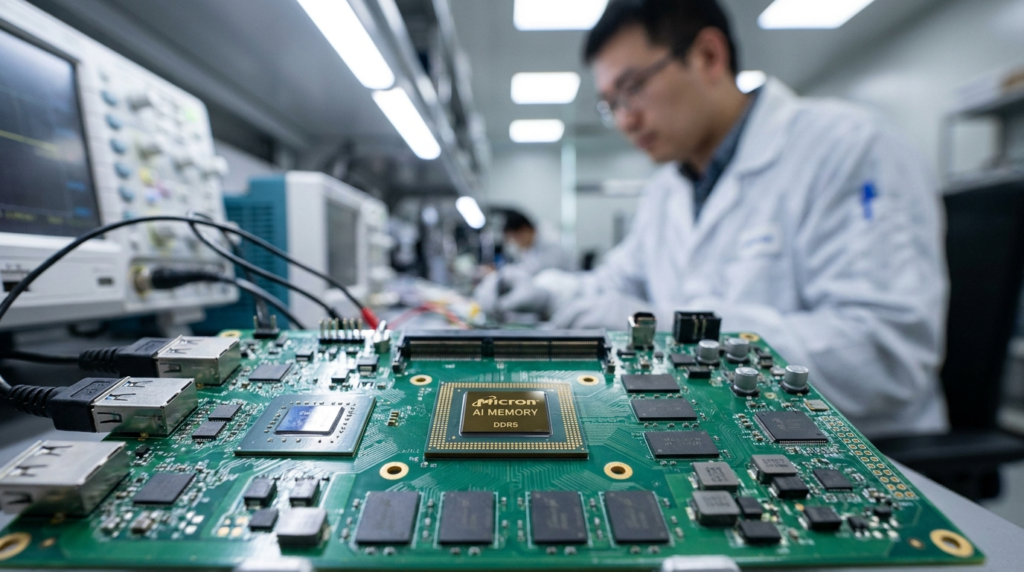

- Micron stock surged 15% after reporting Q3 2026 revenue of $41.46 billion — nearly four times its year-ago figure and well ahead of the $35.84 billion Wall Street estimate.
- Net income hit $28.24 billion ($24.46/share), up from just $1.89 billion ($1.68/share) a year earlier, with gross margin expanding to a record 84.9%.
- Q4 2026 revenue guidance came in at approximately $50 billion — a number that stunned even the most bullish analysts on the street.
- HBM (High Bandwidth Memory) chips are sold out for all of 2026, giving Micron an extraordinary pricing environment that few semiconductor companies have ever enjoyed.
- Micron signed 16 long-term customer agreements worth approximately $22 billion, including $18 billion in cash deposits from data center operators and automakers.
- Micron stock hit a $1 trillion market cap, briefly passing Meta and Tesla in the rankings of America’s most valuable companies.
What Happened?
Micron stock made history on June 25, 2026. After reporting fiscal third-quarter results that shattered every meaningful benchmark on Wall Street, shares of the Boise, Idaho memory chipmaker closed up 15.7% — one of the largest single-day gains for a company of its size in recent memory.
The numbers behind the rally were staggering. Micron stock was rewarding investors who had held through prior memory downturns with a payoff that few could have predicted even twelve months ago. Revenue for the quarter came in at $41.46 billion versus analyst estimates of $35.84 billion, representing a 345% increase from the $9.36 billion reported in the same period a year earlier. To put that in perspective: Micron added more revenue in a single quarter than its entire annual revenue from just three years ago.
But it was not just the top line. Gross margin expanded to 84.9% from 74.9% in the prior quarter and just 39% a year earlier. Net income hit $28.24 billion, or $24.46 per diluted share, compared with $1.89 billion and $1.68 per share in Q3 2025. The company also raised Q4 2026 guidance to approximately $50 billion in revenue — a figure that, if achieved, would make a single Micron quarter larger than most semiconductor companies’ entire annual revenue.
In after-hours trading following the earnings release on June 24, Micron stock pushed the company’s market capitalization above $1 trillion for the first time ever, briefly ranking it above Meta Platforms and Tesla among America’s most valuable public companies.
Why It Matters
The Micron story matters far beyond one stock or one quarter. It reflects something fundamental happening in the technology economy: artificial intelligence has made memory the most strategically scarce resource in computing.
For decades, DRAM and NAND flash memory were commodity products — necessary, unglamorous, cyclically crushed when supply outpaced demand. The companies that made memory spent years in brutal price wars, and investors learned to treat the sector as a boom-bust cycle you timed rather than a structural story you owned. Micron stock itself lost more than 50% of its value during the 2022-2023 memory glut.
What changed is the explosion of AI model training and inference at scale. Large language models, vision systems, and agentic AI architectures demand enormous quantities of High Bandwidth Memory — a specialized chip that sits directly on AI accelerators, allowing GPU clusters to feed data to processing units fast enough to keep up with the computation. That chip, HBM, is extraordinarily difficult and expensive to manufacture, and only three companies in the world can make it: Micron, SK Hynix, and Samsung.
Micron’s entire 2026 HBM production is already sold out. Every unit is contracted, priced, and spoken for before it comes off the production line. That dynamic — structural scarcity driven by AI infrastructure buildout — is what is producing the 84.9% gross margins that analysts once reserved for software companies, not chipmakers.
The broader semiconductor market felt the aftershock. As we covered in our report on OpenAI and Broadcom’s new AI chip strategy, the entire industry is realigning around AI-specific compute — and memory is at the center of that transition. Chip stocks across the sector rose in sympathy following Micron’s results.
Expert Analysis: Bulls vs. Bears
Wall Street analysts responded to the Micron earnings print with a wave of price target upgrades that, taken together, tell a story of genuine belief that something structurally different is happening in the memory industry.
Needham raised its target to $1,550. UBS went to $1,625. Stifel moved to $1,500. TD Cowen matched Stifel at $1,500. Aletheia Capital came in at $1,600. Even more conservative shops like Wedbush ($1,300) and Bernstein ($1,300) increased their forecasts substantially. The common thread is the argument that HBM demand is not a cycle — it is a structural shift that will play out over years as AI infrastructure investment continues to accelerate.
“The role of memory in AI is not cyclical,” one analyst note from a major investment bank observed. “The data center buildout is happening in real time, the customers are locked in on three-to-five year agreements, and Micron is collecting cash deposits upfront. This is a different business than the one that existed in 2022.”
Not everyone agrees. Goldman Sachs remains the notable bear on Micron stock with a price target near $400, a position that puts it sharply at odds with the consensus. Goldman’s thesis is that memory markets have always been cyclical, that today’s extraordinary margins represent a peak rather than a floor, and that supply additions from Samsung and SK Hynix will eventually restore pricing competition. Memory, Goldman argues, is not software — assets do not appreciate forever when supply can be built.
The tension between these two camps — structural transformation versus cyclical peak — is the essential investment debate around Micron stock in 2026.
Micron Stock Market Impact
Micron stock’s post-earnings move did not exist in isolation. It was part of a broader positive session for semiconductor names and helped push the Dow Jones to a new record above 52,655 as investor risk appetite remained elevated heading into the end of June.
By late June 2026, Micron stock was trading in the $950 to $1,100 range, up more than 700% over the prior twelve months. The rally has taken the company from a mid-cap cyclical chipmaker to a $1.2 trillion technology giant in roughly two years — a compression of value creation that is nearly unprecedented in the semiconductor sector.
The data center segment was the headline driver. Data center revenue climbed more than sevenfold year-over-year to $11.5 billion from $1.53 billion in the same quarter a year earlier. That single segment now generates more revenue than Micron’s entire company did just a few years ago.
Social and retail investor sentiment around Micron stock turned sharply bullish following the results, according to analysis across Reddit, X, and financial discussion forums. Community discussions centered on the raised price targets, the HBM supply constraints, and the long-term customer agreements. A trending thread on X from a prominent semiconductor analyst captured the mood: “Micron just proved that memory is now a structural AI play, not a commodity.” Retail investors on Reddit’s r/investing and r/wallstreetbets communities echoed the structural bull thesis, though several contrarian voices noted that Goldman’s bear case deserved more attention than the market was giving it.
This mirrors the pattern we saw in late June with broader equity market momentum, where AI-linked stocks continued to outperform even as rate uncertainty persisted.
AI Perspective: Is the Memory Boom Structural?
Stepping back from the quarter itself, the question that matters most for investors in Micron stock is whether the AI-driven memory boom is a durable structural shift or an eventual cycle that will mean-revert like all prior memory markets.
The bull case rests on several pillars. First, the nature of AI infrastructure spending is different from consumer or enterprise IT demand. Hyperscalers — Amazon, Google, Microsoft, Meta — are not buying memory chips for a product cycle. They are building out data center capacity that requires persistent, long-term memory supply, and they are signing contracts accordingly. Micron’s 16 long-term agreements, covering $22 billion in revenue with $18 billion in upfront cash deposits, reflect customers who are not treating memory as something they can defer or substitute away from.
Second, HBM is not a standard memory product. The manufacturing process is significantly more complex than conventional DRAM, the yields are harder to achieve at scale, and the design integration with AI accelerators requires deep collaboration between Micron and its customers. That creates switching costs and long design cycles that are fundamentally different from the commodity memory markets of the past.
Third, the demand trajectory shows no near-term ceiling. AI model sizes are growing. Inference workloads are multiplying as AI moves from research into production at scale across industries. Each new generation of AI accelerator requires more HBM, not less.
The bear case, as Goldman Sachs articulates it, is that Samsung and SK Hynix are not standing still. Both companies are investing aggressively in HBM capacity, and as supply catches up to demand over 2027 and 2028, the extraordinary pricing environment that is producing 84.9% margins will erode. Memory has always been a feast-and-famine cycle, and there is no law of physics that exempts HBM from that reality.
For now, Micron stock is trading as though the bulls have won the argument. Whether that verdict holds will depend on how quickly competitive supply enters the market — and whether AI infrastructure spending continues to grow faster than the industry can build memory to serve it.
Who: Micron Technology (NASDAQ: MU)
What: Q3 2026 earnings beat with revenue of $41.46B and net income of $28.24B
When: Results reported June 24, 2026; stock surged June 25, 2026
Where: U.S. markets; Micron is headquartered in Boise, Idaho
Why: AI-driven demand for High Bandwidth Memory (HBM) chips created record revenue, margins, and forward guidance
Impact: Micron stock crossed a $1 trillion market cap; semiconductor sector rallied broadly; Q4 guidance of $50B signals continued strength
Frequently Asked Questions
What happened to Micron stock today?
Micron stock surged 15.7% on June 25, 2026 after the company reported Q3 fiscal 2026 revenue of $41.46 billion — nearly four times higher than the same quarter a year ago — driven by unprecedented demand for AI-related High Bandwidth Memory chips.
What is HBM and why does it matter for Micron?
High Bandwidth Memory (HBM) is a specialized chip that sits directly on AI accelerators, allowing GPU clusters to process data fast enough to support large-scale AI training and inference. Micron’s HBM production for all of 2026 is already sold out, giving the company exceptional pricing power and margin expansion.
What is Micron’s Q4 2026 revenue guidance?
Micron guided for approximately $50 billion in revenue for fiscal Q4 2026, up from $11.3 billion in Q4 2025 — a 342% year-over-year increase if achieved.
Is Micron stock a buy in 2026?
Analyst opinions are divided. The majority of Wall Street analysts have significantly raised price targets, with targets ranging from $1,250 to $1,625. Goldman Sachs is the notable exception with a target near $400, citing cyclical risks and eventual supply normalization. Investors should conduct their own research and consider their risk tolerance.
Did Micron reach a $1 trillion valuation?
Yes. Following the Q3 2026 earnings report, Micron stock briefly pushed the company’s market capitalization above $1 trillion, making it one of only a handful of U.S. companies to reach that milestone.
Conclusion
Micron stock’s 15% surge following Q3 2026 earnings is not simply a story about one good quarter. It is a referendum on whether memory — long the most cyclical, commodity-like corner of the semiconductor industry — has been permanently transformed by the AI infrastructure boom. The evidence from this quarter suggests it has, at least for now. Revenue that quadrupled year-over-year, gross margins approaching software-company levels, a sold-out HBM order book, and $22 billion in long-term customer contracts paint a picture of a company operating in a fundamentally different demand environment than any it has experienced before.
The dissent from Goldman Sachs is worth keeping in mind. Memory cycles have surprised optimists before, and the entry of additional HBM supply from Samsung and SK Hynix could reshape the pricing environment faster than the bull case assumes. But for investors watching Micron stock in mid-2026, the structural argument is winning. A $50 billion Q4 guidance number will test that conviction by the end of summer.
Sources
- CNBC: Micron soars 15% after blockbuster earnings
- Yahoo Finance: Micron Technology (MU)
- Seeking Alpha: Micron Hits $1 Trillion
- Community research: Reddit, X, and investor forums
Disclaimer: This article is for informational purposes only and does not constitute financial advice. Investing in stocks involves risk, including the possible loss of principal. Always consult a qualified financial adviser before making investment decisions.